Bookly
A mobile funnel for validating children's English audio stories: AI‑assisted content prototype, quiz, paywall, email capture, and a willingness‑to‑pay decision.
Context
Bookly started with a parent pain point: English should fit into a child's day, but lessons and apps require discipline, dedicated time, and often create resistance. Audio stories already exist in children's behavior as calm bedtime content or an alternative to cartoons.
Hypothesis: if English is embedded inside a familiar audio story, a child can learn without feeling like this is another lesson.
Idea Validation
The project had two hypotheses: educational — can children understand English words embedded into Russian‑language context without immediate translation duplication; and commercial — are parents willing to pay if the value is explained through a short personalized funnel?
I started not with an app, but with the core value: content and willingness to pay. If parents do not see value at the promise and prototype stage, a full product will not save the idea.
Content Prototype
For the first validation, I used public domain books, adapted the texts with GPT, and created two versions: simplified A2 English and a hybrid RU + EN format. Audio was generated with 11Labs, then tested with children.
The validation showed that the “English → translation” pattern breaks listening: the child starts waiting for the Russian duplicate and listens less to the English. Research is not as simple as “translation is harmful”: glosses can help vocabulary, but context quality and repeated encounters are critical. So Bookly's principle became: do not translate every phrase, but reveal meaning through the scene, action, and familiar Russian context.
The product direction included three difficulty levels: a simple RU + EN hybrid, a middle level with much more English, and a difficult A2 example almost entirely in English. Below are the two edge audio prototypes.
Audio prototype: English‑only version
Audio prototype: hybrid RU + EN version
Funnel Instead of Product
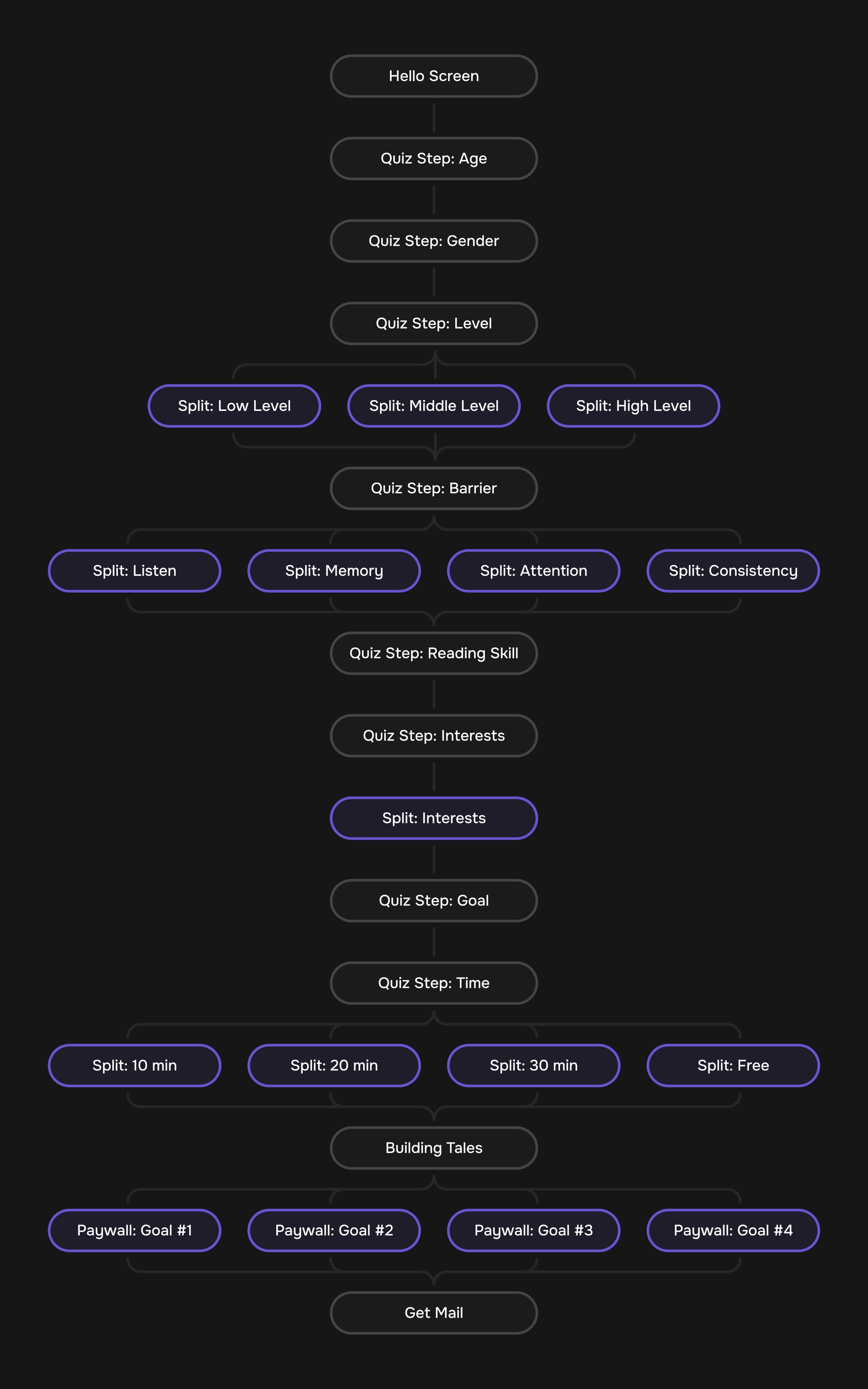
After validating the format, I built a mobile funnel that simulated the product before development: intro, child‑related questions, personalized screens, matching, paywall, and email capture.
The scenario was JSON‑driven: 25 steps, branching, auto‑advancing, progress persistence, PostHog events, paywall variants, and email capture. Before the paywall, a loading screen imitated story personalization for the child: difficulty, length, pace, and genres.
Key Screens
The interface was designed as a mobile funnel, not a landing page. The main screen launched the quiz immediately, questions were short, CTAs stayed fixed at the bottom, and info screens explained Bookly's value through the child's situation.
- “What is the hardest part of English right now?” moved the conversation into a concrete pain: listening, words, focus, or consistency.
- “What is your goal for listening to stories?” let the funnel speak to bedtime, listening comprehension, language growth, or an alternative to cartoons.
- “What stories does your child like most?” created a sense of genre‑based personalization before a real catalog existed.
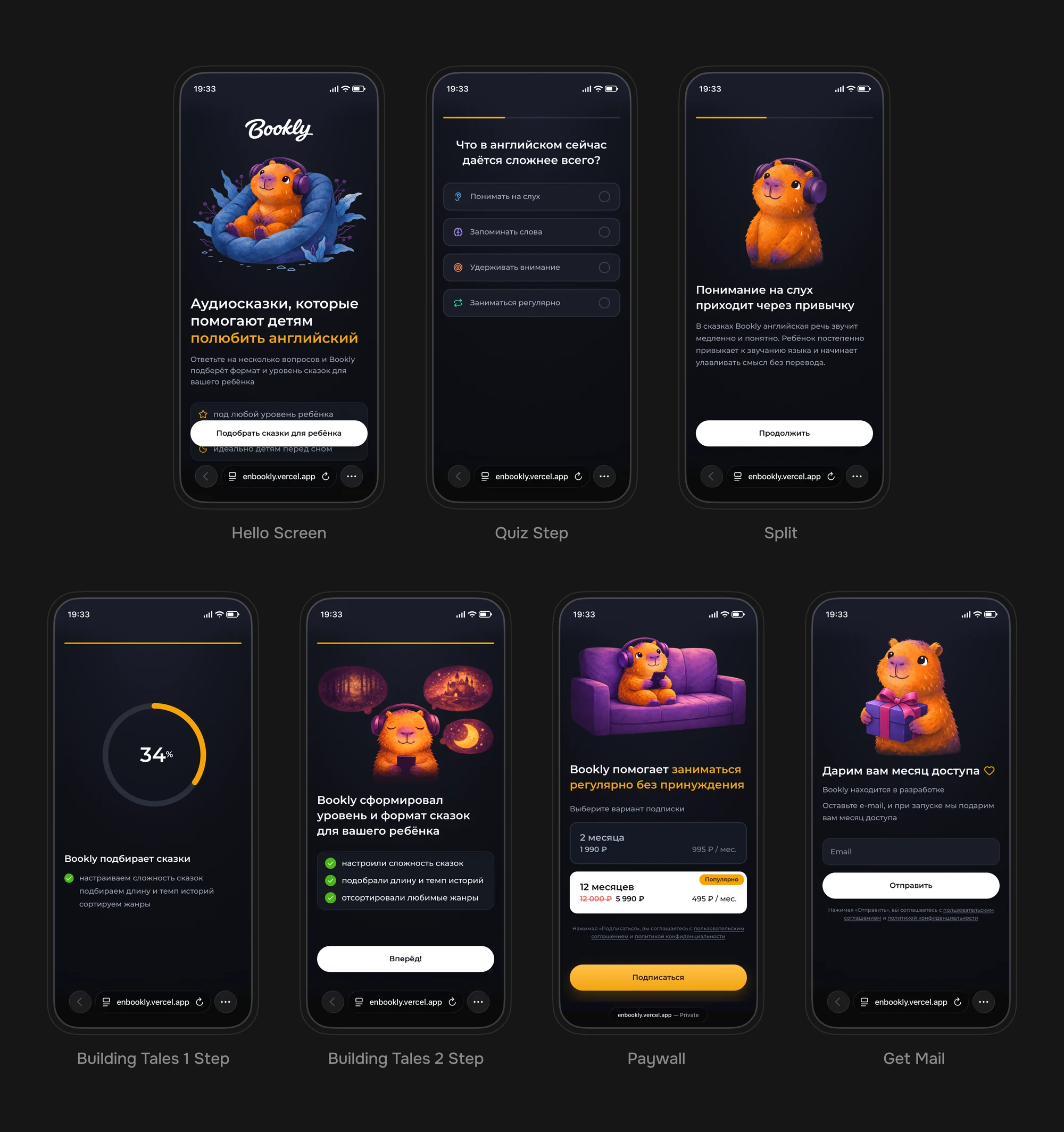
Personalization here was not about a complex algorithm, but about perception: the parent should feel that the product understands their child's situation.
Tools
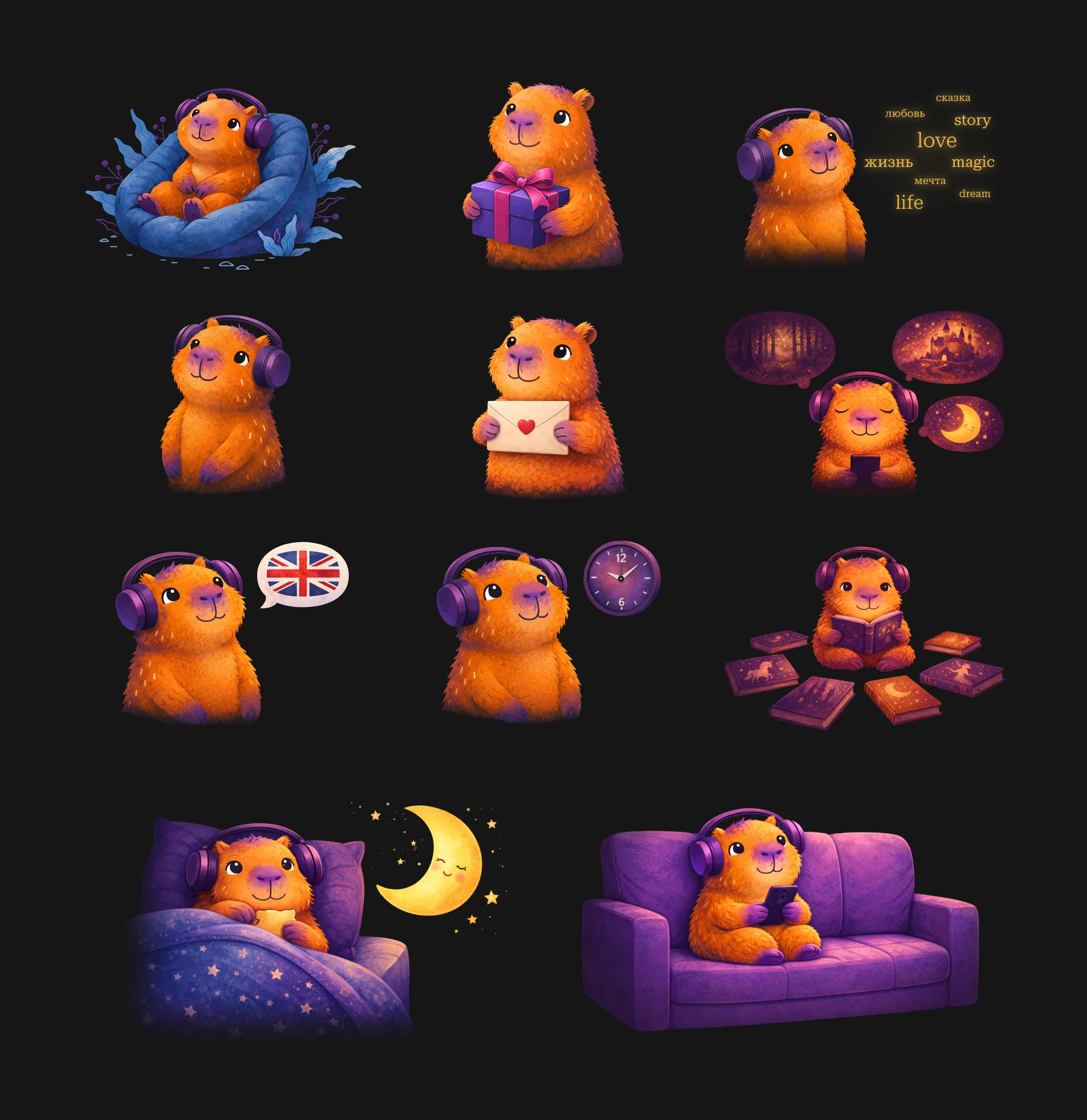
- DALL·E — generating the Bookly character and logo.
- GPT — research, adapting the original text into A2 and hybrid RU + EN formats, funnel copy, and educational explanation variants.
- 11Labs — audio story prototypes. The prototypes were made before 11Labs released advanced audiobook‑focused audio features.
- Codex — funnel development with Next.js, React, TypeScript, Tailwind, Zustand, and Zod.
- Vercel — hosting the live funnel.
- PostHog — events, step completion, and funnel analysis.
- Supabase — database for email leads and launch data.
Demand Validation
To validate willingness to pay, I ran two iterations through VK Ads. The first tested the basic positioning of English audio stories; the second emphasized emotional value: learning without pressure and a calm ritual for the child.
The top of the funnel showed moderate interest: people clicked the ads and started the quiz, but only a small share reached email capture. Interest dropped even further at the paywall. The format looked interesting, but not promising enough as a paid product.
Decision to Stop
The main product takeaway: good packaging, a character, a smooth funnel, and personalized screens do not compensate for weak perceived value at purchase. The content idea looked promising, but the business hypothesis was not validated.
So the project was stopped at the validation stage. That is the value of a 0→1 approach: do not build a full product until the market shows willingness to pay.
Takeaway
Bookly is a case about validating an idea before building the product: AI content prototype, personalized funnel, analytics, paid traffic, and the decision not to continue when the business hypothesis was not validated.